Australian politics: A laugh a minute

April 24th, 2008

Liberal MP Tony Abbott stands alongside a cardboard cutout of Australian Prime Minister Kevin Rudd

Politics in Australia is best described as a spectator sport, and there’s never a dull moment. From massive U-turns through to practical jokes, jibes, personal insults, bribery, corruption and scandal, Australian politicians make their UK counterparts look like model, if dull, citizens.

Gong-gate

Take the recent corruption scandal in Wollongong, for example. Wollongong is New South Wales’ third biggest city, about an hour south of Sydney. As a city, it’s a lot less built-up than Sydney - but thanks to alleged bribes, sexual relations between developers and the town planner, and blackmail, lots of rather large buildings are now in Wollongong that perhaps shouldn’t have been built.

The corruption is said to run deep, even up to the level of the State Labor government. In fact, Wollongong council was so incompetent that it has now been sacked and put into administration - a story I’m personally familiar with, as our local council, Warringah, has also been in administration for the last 5 years for similar reasons. This seems to be a bit of a trend.

A Ruddy good laugh

Then there’s the Kevin Rudd cardboard cut-out affair. Pictured above, we see a real Tony Abbott (the MP for Warringah, as it happens) standing shoulder-to-shoulder with a fake Kevin Rudd. Why? It was a protest by Liberal and National MPs about Kev and his mates not turning up to a sitting of backbenchers in the House of Representatives. Obviously in an age of climate change worries, spiralling inflation and interest rate hikes, the most important thing on the political agenda is whether the PM turns up to a sitting or not.

The event certainly had comedy value if nothing else. In fact I’m surprised there’s no “best of” DVD of classic Australian parliamentary debates. (Now there’s an idea.)

Keating, Master of Insults

Bill Bryson offers an excellent summary of Aussie politics in his book, Down Under. “You’ll never understand Australian politics,” he says, and I’m inclined to agree with him. He also recalls a parliamentary debate between a Wilson Tuckey and ex-Prime Minister, Paul Keating:

Tuckey: “You are an idiot. You are just a hopeless nong…”

Keating: “Shut up! Sit down and shut up, you pig… Why do you not shut up, you clown?”

Paul KeatingPaul Keating

In fact, Paul Keating’s outbursts are so legendary that there’s even an entire mini-site devoted to his insults. Some of my personal favourites include:

“(Peter Costello) has now been treasurer for 11 years. The old coconut is still there araldited to the seat.”

“For Mr (John) Howard to get to the high moral ground, he would first need to climb out of the volcanic hole he had dug for himself over the last decade. It is like one of those diamond mine holes in South Africa. They are about a mile underground. He would have to come a mile up to get to even equilibrium let alone have any contest in morality with Kevin Rudd.”

Priceless. Who needs comedians when you have Australian politics? :)

Where to live: Blue Mountains?

March 24th, 2008

We’re planning on leaving Sydney in the next year or so, due to starting a family and needing a 4-bedroom house. But where to move to? The choice is overwhelming. In this series of posts, I explore a plethora of possible places - many of which we’ve visited - in an attempt to reach some sort of conclusion. Next up - the Blue Mountains.

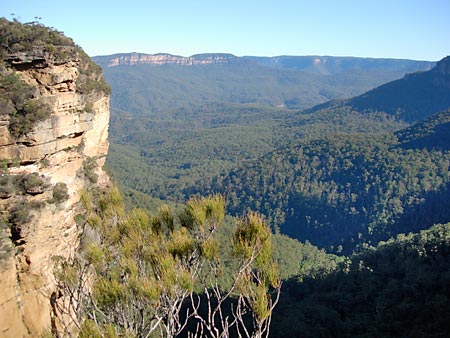
The Blue Mountains is a mountainous (Swiss people would call it “hilly”) area west of Sydney. It’s an area that has always appealed to us, ever since we moved to Australia. It has a winning combination of stunning scenery and lookouts, excellent bushwalking, relaxed atmosphere, and great shopping and dining. Another plus is that it’s big on natural therapies, which is great for my wife’s Bowen Technique and meditation business. Houses are very affordable too.


View Larger Map

About the area

The “Blueys” can be split into the Lower Mountains, and the Upper Mountains. We’re more keen on the Upper Mountains area; it’s further from Sydney, but it has wonderful scenery and it’s cooler in summer. The Lower Mountains area turns into an oven on some summer days.

The main towns in the Upper Mountains are Katoomba, Leura, Wentworth Falls, and Blackheath. We’d consider moving to Leura or Blackheath, which are both small, lovely towns. (The biggest town, Katoomba, doesn’t seem as nice, though it has the biggest range of eateries.) When we visit we nearly always stay at Bethany Manor B&B in Leura - a place I can highly recommend for its quiet, laid-back atmosphere, luxurious (and huge!) spa baths, welcoming hosts, and superb breakfasts.

The Upper Mountains are generally a bit cooler than Sydney in the summer, and a lot cooler in winter; it can even snow sometimes. I find the cold winters slightly off-putting as I like warm weather. It does mean that the area has four distinct seasons though, with beautiful, European-style trees and gardens. All the main towns are well connected by train to Sydney, though the two hour journey from Sydney Central to Leura is a bit of a slog.

View from a lookout in the Blue Mountains

So what’s not to like?

As a place to live, the Blue Mountains have two main drawbacks for us. Firstly, they’re a long way from the sea; according to Google Maps, it takes 1 hour 55 minutes to drive from Leura to Bondi (its nearest beach!). Secondly, you get the impression that, as an economic area, it’s not going anywhere; property prices and population have remained practically static the last few years, and there’s not a great deal of new industry springing up. (This is partly due to all the towns being on a ridge, so there’s not a lot of land for agriculture or industry.) Unemployment is fairly high, and there’s not a lot of activities for kids, so it’s possibly not the best place to raise a family.

Still, drawbacks aside, the Blueys does look like a nice place to live if you’re after peace and quiet, beautiful scenery, a cooler climate, and a relaxed atmosphere.

The Aussie petrol price lottery

March 15th, 2008

Petrol droplet with dollar signNow that we have a car, we’re obviously buying a lot of petrol. I have to say, the way they price petrol in Australia is insane. It’s cheap enough - compared to the UK, that is - but you never know what the price is going to be one day to the next. They change the prices every day! At least in the UK if fuel was £1 a litre one day, there was a reasonable chance it’d be £1 a litre the next day. Here in Sydney, it might be $1.29 a litre on Wednesday, $1.40 a litre on Thursday, then back down to $1.35 a litre on Friday!

So what gives? According to the Australian Competition and Consumer Commission (ACCC), petrol prices are subject to all sorts of factors, including international wholesale prices and movements in the exchange rate. But do petrol stations really have to change their prices every single day? Just think of the wasted time and effort changing all those signs each morning! (Well it keeps the petrol station owners fit, I guess.) In fact, sometimes they change prices several times a day! Talk about a lottery.

Anyway, for the record it appears the best time to buy fuel in Sydney is on a Tuesday, and the worst day of the week is Thursday. So now you know.

Where to live: Jamberoo?

February 26th, 2008

We’re planning on leaving Sydney in the next year or so, due to starting a family and needing a 4-bedroom house. But where to move to? The choice is overwhelming. In this series of posts, I explore a plethora of possible places - many of which we’ve visited - in an attempt to reach some sort of conclusion. Next up - Jamberoo.

We’d spent a long time looking at towns north of Sydney, but nothing really seemed to appeal. So we started searching south. Cat suggested Jamberoo, as it was a pleasant-sounding village in beautiful countryside.

It really is a nice place. Small (around 1,000 people), with attractive buildings and a great village atmosphere. It’s only 10 minutes’ drive from Kiama and the sea, and 1 hour 40 minutes from the Harbour Bridge. The countryside is simply stunning, with lush green rolling hills (it’s dairy country), and spectacular views to the escarpment to the west. It’s very English; in fact it even has dry stone walls, which are very rare in Australia. A chap called Thomas Newing brought over the skill from Kent.


View Larger Map

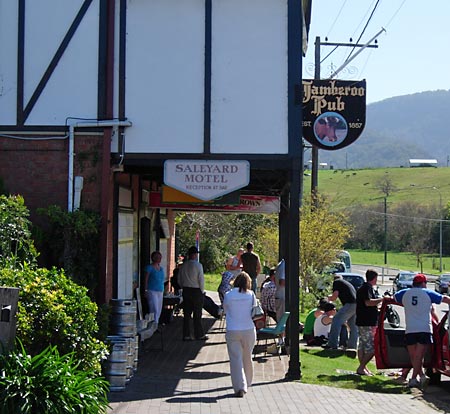
To add to the English theme, the Jamberoo Pub is a marvellous mock-Tudor affair, with a good atmosphere and a decent selection of beer. A decent pub is certainly one of my priorities!

Jamberoo Pub

There are lots of great bushwalks in the nearby national parks - another of my priorities - with some wonderful views from lookouts such as Saddleback Mountain. The locals are friendly and laid-back, and the whole village has a relaxed, welcoming feel. And if we ever fancy a Gold-Coast-style break away from it all, the Jamberoo Action Park is just up the road!

The only real drawback to Jamberoo is the property prices - you’ll be pushing it to get a 4-bedder under $500k. When we first looked there were a couple around the $450k mark, but we were lucky (or you might say unlucky, since we didn’t buy one of them!). Other more minor concerns are the lack of decent public transport (so one of us would be stranded at home while the other went out in the car), and the quiet nature of the village - there’s really not a lot to see or do in the village itself.

We do really like Jamberoo though, so if something comes up in our price range, we’ll be very tempted…

Where to live: Kiama?

February 7th, 2008

We’re planning on leaving Sydney in the next year or so, due to starting a family and needing a 4-bedroom house. But where to move to? The choice is overwhelming. In this series of posts, I explore a plethora of possible places - many of which we’ve visited - in an attempt to reach some sort of conclusion. Next up - Kiama.

Kiama is a reasonably large coastal town about 1 hour 40 minutes south of Sydney. It’s famous for its blowhole - a hole in the rocks where the sea crashes through, sending spray high into the air. (It’s been known to claim a few unfortunate souls who stood too close to it!)


View Larger Map

In theory, Kiama should be the perfect place for us. It’s not too far from our friends and the attractions of Sydney; it’s by the sea, and has some reasonably nice beaches; it’s a decent size. But there’s something about Kiama that doesn’t quite gel for us. It feels very suburban and, indeed, is almost a suburb of Wollongong these days. The shops and cafes don’t seem particularly nice or welcoming, and the town seems to have a bit of a down-at-heel vibe to it somehow. People don’t seem as friendly as they do in many other small towns in New South Wales. It doesn’t seem to have much of a sense of community. Maybe this is just subjective stuff - who knows?

It’s also pushing our budget somewhat; we’d have to wait a while to find a 4-bed house in our price range. We did actually look at a house that we could afford - I think it was $430,000 - and it seemed OK, but not many come up at that price. It was also suspiciously near the main highway, so I suspect trucks at night could have been a problem. (Always worth visiting potential houses late at night if they’re near big roads, just to check!)

On the plus side, Kiama is pleasant enough as a place to visit, with attractions such as the blowhole, feeding pelicans, a lighthouse, and lovely scenery to the west. I’m just not sure it’s the right place for us to settle down.

Voting in Australia: easier said than done

January 11th, 2008

Voting X on ballot paperHappy New Year, dear reader!

If you’re an Australian citizen, as we now are, then you have to vote in elections here. Well, you don’t have to, but if you don’t you get a slap on the wrist in the form of a $25 fine, though it can go up to as much as $70 if they get really cross with you. In many ways I’m not surprised they have to force people to vote, because voting is so damn confusing here. For starters, there are three types of election in Australia:

  • Local government elections. These are where you elect the councillors that form your local council. Council areas are often divided into wards if they’re big.
  • State elections. In these elections, you decide who will run the state - in our case, New South Wales.
  • Federal elections. These elect the federal government (the one that runs the whole country).

To add to the confusion, there are two chambers in the Australian parliament that you have to vote your favourite pollies into. There’s the Senate, which is the upper chamber, and the House of Representatives, which is the lower chamber. From what I can tell, they both do the same sort of thing: argue about stuff for days on end, then eventually pass the odd law or two. The main difference is that the House of Representatives is, well, representative - the number of elected members for each party proportionally represents the number of people who voted for them - while the Senate always has twelve senators for each state. Yes, that means twelve senators for Tasmania (pop. 450,000) and twelve senators for New South Wales (pop. 6 million). Go figure.

I hope they recycle the ballot papers

So why do you need to know all this? Because when you vote, you get not one ballot paper, but two. The House of Representatives one is relatively straightforward; you have, say, six people you can vote for, one from each party. The slight catch - compared to, say, the UK - is that you have to vote for all of them! You don’t just put a X in your chosen box; you have to write a 1 for the pollie you hate the least, then a 2 for the slightly more onerous one, all the way up to a 6 for the bugger you want to get rid of. (This is known as preference voting.)

Once you’ve digested the entrée that is the House of Representatives paper, it’s time to move onto the main course: the Senate ballot paper. This is of truly epic proportions. The one in the recent federal election was so wide that I couldn’t fit it all in the booth without curling it up. Here you get a choice of how to vote (whoopee!): you can simply write the number 1 next to your chosen party in the list above the line, or, if you’re really bored, you can write 1, 2, 3, etc for each and every candidate in the list below the line. Bearing in mind the below-the-line list can contain as many as 60 candidates - and if you make a single slip-up your vote is void - it’s not surprising that 95% of people vote “above the line”.

Once you’ve done all that, you fold up your papers, stick them in the box, go home, and have a well-deserved lie down.

If you’re still confused about how to vote in Aussie elections, good old Wikipedia has the full gory details. The AEC also has useful practical info on the subject, which is just as well.

Australia: The Car Country

December 24th, 2007

Map of Australia with car iconThere’s no doubt about it - Australia is a nation of car drivers. It’s understandable in a way, when you consider the size of the place. (You can’t really expect decent public transport in the middle of the Outback.) However, even in major cities like Sydney with good public transport networks (in my opinion!), cars rule the roost:

  • People tend to look at you strangely if you don’t drive a car
  • Many roads in the suburbs don’t even have pavements (sidewalks if you’re American) - presumably you’re supposed to drive everywhere, or take your chances walking in the road
  • Fuel is cheap (compared to the UK, anyway)
  • Many couples have two cars (one car each)
  • Sydneysiders love their nice big gas-guzzling 4×4s (complete with roo bars to protect them from all those feral urban kangaroos bouncing down the high street)
  • “Camping” for Aussies means taking a tent the size of a small house, 4 fold-up tables, 8 chairs, 2 BBQs, and a portable shower - which of course, means at least one car if not two
  • Trains are so slow when you get out of Sydney that you’d be crazy not to go by car. For example, it takes 1.5 hours to drive to Kiama on the south coast (120km south of Sydney), but 2.5-3 hours to go by train. Read the rest of this entry »

Where to live: Morpeth?

December 15th, 2007

We’re planning on leaving Sydney in the next year or so, due to starting a family and needing a 4-bedroom house. But where to move to? The choice is overwhelming. In this series of posts, I explore a plethora of possible places - many of which we’ve visited - in an attempt to reach some sort of conclusion. Next up - Morpeth.

Morpeth is a sleepy little village of just over 1,000 inhabitants. It’s on the edge of the Hunter valley, northwest of Newcastle, and sits on a gentle bend of the Hunter river.


View Larger Map

Unlike many country towns in Australia, Morpeth actually has a bit of history to it, which appeals to us. It used to be a river port, transporting coal and people via steamer to Paterson, Maitland, Newcastle and Sydney. The village is full of historic sandstone buildings, including the riverside Arnott Bakehouse, owned by the original Arnott family (of biscuit fame). In fact the village is so historic that it has National Trust status.

The Hunter River at Morpeth

A big plus with Morpeth is that it’s just 37km from a big city - Newcastle - which means you’re never that far from the action (though if you’re not driving then it’s a 6km walk or cycle ride to the nearest train station in East Maitland). It’s almost exactly 2 hours’ drive from Sydney, too, should we ever need to head into the Big Smoke. It’s well served by schools, with a primary school in town and two good public high schools in East Maitland. Read the rest of this entry »

How to survive a long overseas trip with a baby

December 3rd, 2007

Flying over Sydney

I’ve just come back from a mammoth 7-week trip to Dubai and the UK with my wife and 9-month-old son, Zack. Quite a trip! I thought I’d offer some hints and tips for those of you expats making the trip over to the mother country to introduce your kid to their grandparents:

  • Book your flights online. You can save a fortune compared with high street travel agents by booking directly with the airline on their website. We flew with Emirates and saved ourselves AUD $800 in total. Note that most airlines charge a 10% fare for under-twos.
  • Book bulkhead seats. (Assuming you’re flying economy.) These are seats that sit directly behind the bulkheads (dividers) on the plane, usually just behind business class. They offer a lot more legroom, and you usually get the option of booking a bassinet (see below). Plus your little one can crawl around a bit on the floor in front of you.
  • Book a bassinet. These attach to the bulkhead in front of the seat. They’re usually fairly small but your baby can lie with their legs over the end if necessary. Even if the baby doesn’t sleep in it, it provides a great place to stash the 3 tons of stuff you end up with (books, magazines, blankets, pillows, food trays, water, toys, …)
  • Be aware of liquid restrictions for air travel. There are exceptions for baby food and so on, but you still need to stick within certain limits. Find out more information on this Australian site.
  • Take your own baby food on the flight. Your baby will prefer familiar food. Although many airlines offer baby food in-flight, your baby may not like what’s available, and the food often has additives such as sugar and salt, too. Bananas are always a good standby when flying.
  • Give your baby something to drink after take-off and before landing. This will help with their ear pain as the pressure changes. Breastfeeding is great and has the added benefit of comforting. Water does the job too. Read the rest of this entry »

Weird Aussie pronunciation

November 1st, 2007

While Australian English is generally close enough to the “mother tongue” to be intelligible to even the most dyed-in-the-wool Pom, we do occasionally get confused by the Australians’ rather odd pronunciation.

When we first arrived in Sydney, I got some strange looks asking for direction to the nearest Dymocks bookshop. I soon found out why - it isn’t pronounced Dye-mocks, it’s pronounced Dimmerks. I believe there’s one fairly near Wynyard station, which - by the way - is pronounced Win-yerd, not Wine-yard.

On a trip down south from Sydney, we quickly learned that Kogarah isn’t pronounced Koe-GAH-rah - it’s pronounced COG-a-rah - while Wollongong isn’t pronounced Wo-lon-gong - it’s pronounced Wool-long-gong, even though there’s no double-o. Those crazy Aussies! Travelling further down the coast, we were amazed to discover that Kiama isn’t pronounced Kee-arma - it’s pronounced Kye-amma - and that Jervis Bay isn’t pronounced Jarvis Bay - it’s actually pronounced Jervis Bay, just like it’s written.

Various other place names have tripped us up over the years. Balgowlah, a Sydney suburb, is pronounced Balg-OW-lah, not BAL-go-lah, while the town of Forster, strangely, is pronounced Foster. One doesn’t pronounce Maleny as MALeny, but as MalAYnee, and you say Merimbula as MerIMbula, not MerimBUla.

If you work with computers and want to ask someone where the router is, don’t be tempted to say rooter, because “root” is Aussie slang for “to have sex”. Instead, make sure you say r-ow-ter. Meanwhile, commenting on an attractive PERgola in the park won’t get you far; try calling it a PerGOla instead for best results.

When ordering a schooner of James Boag in a pub, don’t pronounce it James Bo-ag like I did because the bar staff will think you’re crazy. It’s pronounced James Boge.

Other Aussie oddities include:

  • Data - pronounced darta, not dayta
  • Cache - pronounced cayshe, not cash
  • Eco - pronounced echo, not eeko
  • Project - pronounced pr-oh-ject, not prodject

Finally, even people’s names are pronounced differently. Megan isn’t pronounced, well, Megan as it is in the UK, but Mee-gan. And we were surprised to find that, after naming our baby boy Isaac, all our Aussie friends call him not Eye-zerk, but Eye-zack. (Which we actually quite like, luckily!)